
· By Admin
Puppy Dry Food Feeding Chart for Healthy Growth
A puppy can outgrow a feeding routine almost as quickly as they outgrow a collar. That is why a puppy dry food feeding chart is a useful starting point, not a permanent prescription. Puppies need consistent nutrition to build bone, muscle, immunity, and a healthy digestive system, but the right portion changes with age, expected adult size, activity, and the calorie density of the food in the bowl.
The goal is steady, lean growth - not the fastest possible growth and not a constantly full food dish. A quality dry food designed for growth can provide complete nutrition in a manageable serving, helping your puppy digest more of what they eat and produce less waste. Feed the right amount, monitor the puppy in front of you, and adjust thoughtfully.
How to use a puppy dry food feeding chart
Begin with your puppy's current weight, age, and expected adult size. If you adopted a mixed-breed puppy and their adult weight is uncertain, use your veterinarian's best estimate and reassess as your puppy grows. Large- and giant-breed puppies deserve particular attention because overly rapid growth can put unnecessary strain on developing joints and bones.
Next, look at the calorie content on your food label. Two dry foods may suggest the same number of cups, yet one can contain significantly more calories per cup than the other. For that reason, calories are the most reliable way to compare portions. The chart below gives estimated daily calorie needs, then you can convert those calories into cups using your specific food's feeding guide.
For example, if your puppy needs about 500 calories daily and the food provides 400 calories per cup, the starting portion is about 1 1/4 cups per day. Divide that amount into several meals rather than serving it all at once.
Puppy dry food feeding chart by age and adult size
These daily calorie ranges are general starting points for healthy puppies. Individual needs vary, especially for very active pups, puppies recovering from illness, and dogs with unusually fast or slow growth patterns.
| Expected adult weight | 8-12 weeks | 3-6 months | 6-12 months | 12-18 months |
|---|---:|---:|---:|---:|
| Small, under 20 lb | 250-500 calories | 300-550 calories | 300-500 calories | Transition toward adult needs |
| Medium, 20-50 lb | 400-750 calories | 500-900 calories | 550-1,000 calories | Transition toward adult needs |
| Large, 50-90 lb | 600-1,000 calories | 800-1,300 calories | 850-1,450 calories | May still need puppy food |
| Giant, over 90 lb | 700-1,200 calories | 1,000-1,700 calories | 1,100-1,900 calories | Often remains on growth food longer |
Use the lower end of a range for a calm puppy with a smaller frame and the higher end for a highly active puppy or one with a larger build. This is not a reason to push extra food for a bigger puppy. A balanced large-breed puppy formula and controlled growth rate are generally more helpful than oversized portions.
Converting calories to cups of dry food
Find the calories per cup, or kcal/cup, on the bag. Divide your puppy's daily calorie target by that number. A food with 450 kcal per cup will naturally require a smaller portion than one with 350 kcal per cup.
This is where nutrient-dense food can change expectations. A smaller scoop does not necessarily mean a smaller meal nutritionally. When a dry food is highly digestible and made with quality animal protein and balanced fats, vitamins, and minerals, puppies may need less volume than they would with a lower-quality, filler-heavy formula. Measure every meal with a standard dry measuring cup or, better yet, a kitchen scale for consistency.
How often should a puppy eat?
Young puppies do best with smaller, scheduled meals. From about 8 to 12 weeks, offer three to four meals daily. From 3 to 6 months, most puppies thrive on three meals a day. By 6 months, many can move to two meals daily, though small breeds may benefit from three meals for longer if they struggle to maintain steady energy.
Scheduled meals make it easier to spot a reduced appetite, digestive upset, or sudden increase in hunger. They also support house-training because you can better anticipate potty breaks. Leaving food out all day may seem convenient, but free-feeding makes portion control difficult and can hide changes in appetite that deserve attention.
Fresh water should always be available. If you add warm water to kibble for a young puppy or a pet with sensitive teeth, measure the dry food first so the daily calorie amount remains accurate.
Let your puppy's body condition guide the portion
A chart helps you begin, but your puppy's body condition tells you whether the plan is working. You should be able to feel the ribs with gentle pressure, though they should not be sharply visible. From above, look for a visible waist behind the ribs. From the side, the abdomen should tuck upward rather than hang low.
Weigh your puppy weekly during the early months and keep a simple record of food amount, stool quality, appetite, and body shape. A puppy that is gaining steadily, playing normally, and producing firm, easy-to-pick-up stools is usually on a sound path.
Adjust the daily portion by about 5 to 10 percent at a time, then give the new amount several days before judging the result. Increase modestly if your puppy is becoming too lean, seems persistently hungry despite eating an appropriate food, or is entering a clear growth spurt. Reduce modestly if the waist disappears, ribs become difficult to feel, or weight gain is outpacing healthy body condition.
Avoid making major daily changes based on one skipped meal or one sleepy afternoon. Puppies have off days too. Persistent appetite changes, vomiting, diarrhea, excessive thirst, or lethargy call for a conversation with your veterinarian rather than a larger scoop of food.
Treats, chews, and toppers count too
Training is a major part of puppyhood, and treats can add up quickly. Keep treats, chews, and toppers to roughly 10 percent or less of your puppy's daily calories. The remaining 90 percent should come from a complete, balanced puppy food.
If you use training treats frequently, choose tiny pieces and subtract a little from the meal portion as needed. This matters even more for small-breed puppies, where a few calorie-dense treats can represent a meaningful part of the day's intake. Supplements should also be chosen with care. A complete growth diet already supplies key nutrients, so adding calcium or other growth-focused products without veterinary guidance can create imbalances.
When to switch from puppy food to adult food
Small breeds often reach maturity around 9 to 12 months. Medium breeds commonly transition around 12 months, while large and giant breeds may need a puppy or growth formula for 15 to 24 months. The best timing depends on breed, body condition, and the formula you are feeding.
When it is time to transition, do it gradually over seven to 10 days. Mix a small amount of adult food into the puppy food, then slowly increase the adult food while watching stool quality and appetite. A gradual change is kinder to the digestive system than an abrupt swap.
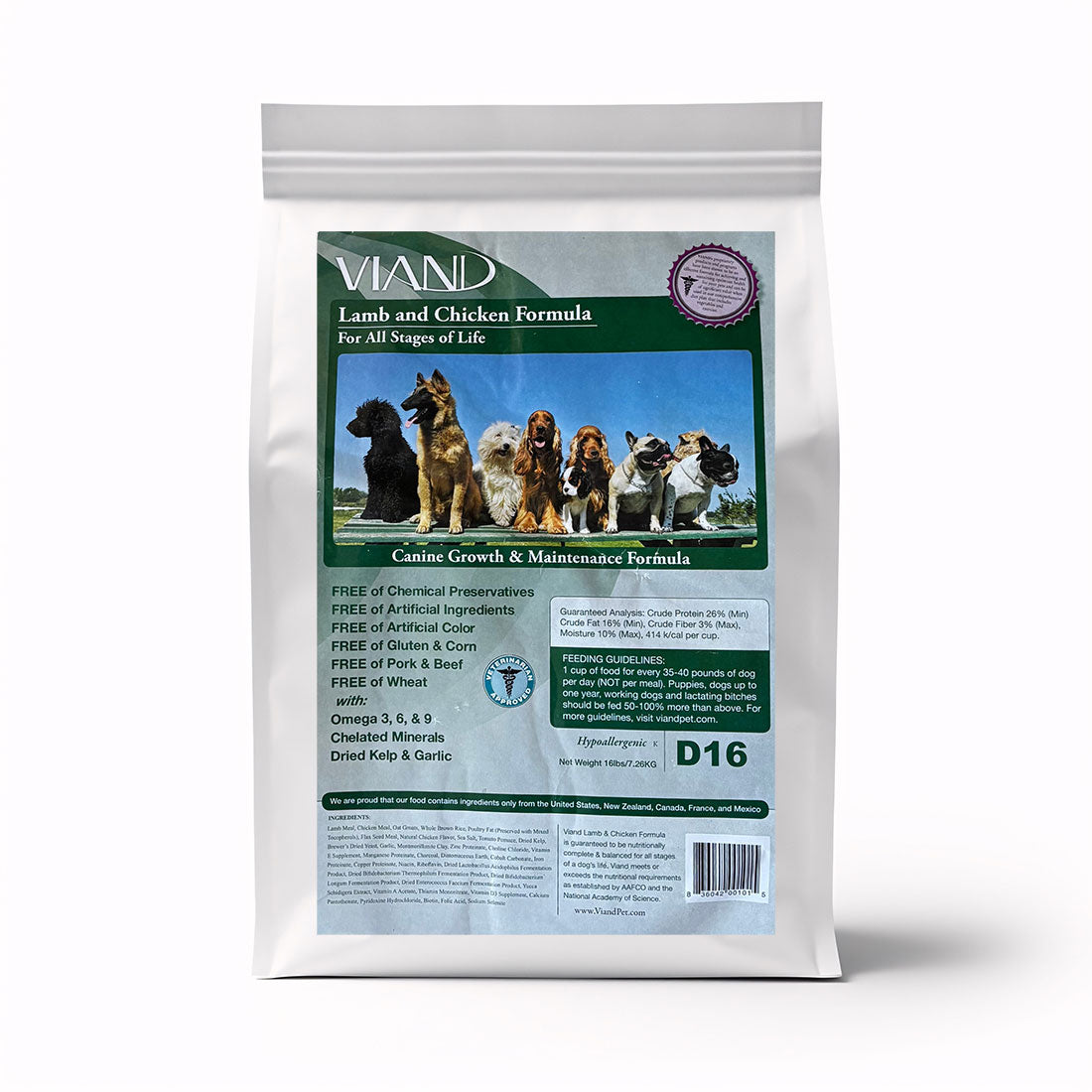
ViandPet's practical approach is simple: use high-quality nutrition as a daily foundation, then let your dog's condition guide the details. The bag's feeding recommendation, this chart, and regular body-condition checks work best together.
Your puppy will not stay the same size for long, so revisit portions every few weeks. Fetch the measuring cup, watch the waistline, and make small, calm adjustments. That steady attention is one of the most practical ways to support a healthy, energetic companion for years ahead.